New publication, Imane Doghman, et al. in J. Med. Virol.
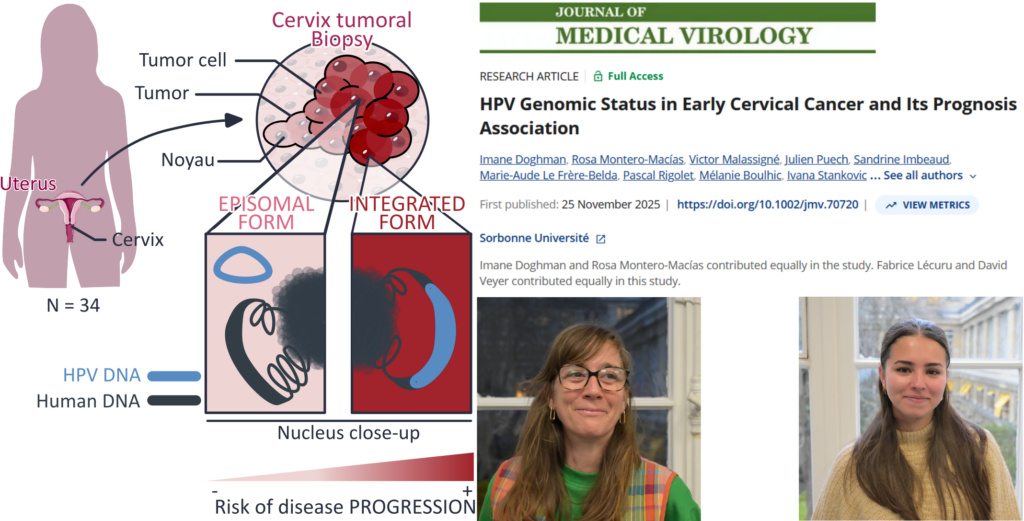
Identify specific Human Papilloma Virus (HPV) genomic status by HPV capture technique coupled with next-generation sequencing (NGS) in patients with early cervical cancer (ECC) regarding 2018 FIGO stages and correlate these statuses with prognosis. HPV sequencing by Capture technique coupled with NGS was performed on 34 tumors samples of ECC patients without histologically sentinel lymph node (SLN) metastasis in a retrospective study. NGS data were analyzed in our in-house VIROCAPT2 pipeline to determine precise HPV genomic status such as the complete sequence of HPV genome, its integration or not in host genome and correlate this viral identity card with patient’s clinical prognosis. As expected, HPV16 remains the most common genotype (60%, n = 21/35) in ECC. HPV integration was identified in 40% (n = 14/35) of samples. We found that in ECC, integration events were related with HPV genotype (p = 0.0005). Among the 40% of integrated HPV, 8 were found integrated within human genes, including 2 into oncogenes. Finally, women with integrated HPV had a poorest outcome with a strong correlation between progression-free survival and HPV integration (p = 0.0035) and interestingly, the 2 HPV integrated into oncogenes were observed in patients who died from cancer. HPV genomic status seems to be a key prognostic factor in early stage cervical cancer, with HPV integration strongly linked to poor outcomes. Larger studies are needed to confirm the clinical relevance of HPV ID card for risk stratification and treatment decisions.

Jessica Zucman-Rossi EASL Recognition Award 2025

The FunGeST team at the Cordeliers Research Centre is proud to share that our group leader, Professor Jessica Zucman-Rossi, has been honoured with the 2025 EASL Recognition Award at the annual congress of the European Association for the Study of the Liver (EASL), a leading international event in hepatology.

This prestigious award recognises both the excellence of her scientific contributions and her strong commitment to collaborative, inclusive, and open research.

What I love most in research is the joy of collective discovery. Sometimes, something clicks, and this is a piece of the puzzle that falls into place that makes our understanding grow. When you begin to experience this, you are completely addicted to research. This type of discovery would not be possible without my team.

Warm congratulations to Professor Jessica Zucman-Rossi on this inspiring recognition, which resonates deeply with the entire Cordeliers Research Centre community!

New publication, Aurore Pire & Théo Z. Hirsch, et al. in Eur J of Cancer

ABSTRACT

Background. Hepatoblastoma is the most frequent pediatric liver cancer. The current treatments lead to 80% of survival rate at 5 years. In this study, we evaluated the clinical relevance of molecular features to identify patients at risk of chemoresistance, relapse and death of disease.
Methods. All the clinical data of 86 children with hepatoblastoma were retrospectively collected. Pathological slides were reviewed, tumor DNA sequencing (by whole exome, whole genome or target) and transcriptomic profiling with RNAseq or 300-genes panel were performed. Associations between the clinical, pathological, mutational and transcriptomic data were investigated.
Results. High-risk patients represented 44% of our series and the median age at diagnosis was 21.9 months (range: 0–208). Alterations of the WNT/ß-catenin pathway and of the 11p15.5 imprinted locus were identified in 98% and 74% of the tumors, respectively. Other cancer driver genes mutations were only found in less than 11% of tumors. After neoadjuvant chemotherapy, disease-specific survival and poor response to neoadjuvant chemotherapy were associated with ‘Liver Progenitor’ (p = 0.00049, p < 0.0001) and ‘Immune Cold’ (p = 0.0011, p < 0.0001) transcriptomic tumor subtypes, SBS35 cisplatin mutational signature (p = 0.018, p = 0.001), mutations in rare cancer driver genes (p = 0.0039, p = 0.0017) and embryonal predominant histological type (p = 0.0013, p = 0.0077), respectively. Integration of the clinical and molecular features revealed a cluster of molecular markers associated with resistance to chemotherapy and survival, enlightening transcriptomic ‘Immune Cold’ and Liver Progenitor’ as a predictor of survival independent of the clinical features.
Conclusions. Response to neoadjuvant chemotherapy and survival in children treated for hepatoblastoma are associated with genomic and pathological features independently of the clinical features.

New publication by Amélie Roerhig, et al. in Nature communications

Hepatoblastomas (HB) display heterogeneous cellular phenotypes that influence the clinical outcome, but the underlying mechanisms are poorly understood. Here, we use a single-cell multiomic strategy to unravel the molecular determinants of this plasticity. We identify a continuum of HB cell states between hepatocytic (scH), liver progenitor (scLP) and mesenchymal (scM) differentiation poles, with an intermediate scH/LP population bordering scLP and scH areas in spatial transcriptomics. Chromatin accessibility landscapes reveal the gene regulatory networks of each differentiation pole, and the sequence of transcription factor activations underlying cell state transitions. Single-cell mapping of somatic alterations reveals the clonal architecture of each tumor, showing that each genetic subclone displays its own range of cellular plasticity across differentiation states. The most scLP subclones, overexpressing stem cell and DNA repair genes, proliferate faster after neo-adjuvant chemotherapy. These results highlight how the interplay of clonal evolution and epigenetic plasticity shapes the potential of HB subclones to respond to chemotherapy.

New publication by Jill Pilet & Théo Z. Hirsch, et al. in Nat. comm

ABSTRACT

Pediatric liver tumors are very rare tumors with the most common diagnosis being hepatoblastoma. While hepatoblastomas are predominantly sporadic, around 15% of cases develop as part of predisposition syndromes such as Beckwith-Wiedemann (11p15.5 locus altered). Here, we identify mosaic genetic alterations of 11p15.5 locus in the liver of hepatoblastoma patients without a clinical diagnosis of Beckwith-Wiedemann syndrome. We do not retrieve these alterations in children with other types of pediatric liver tumors. We show that mosaic 11p15.5 alterations in liver FFPE sections of hepatoblastoma patients display IGF2 overexpression and H19 downregulation together with an alteration of the liver zonation. Moreover, mosaic livers’ microenvironment is enriched in extracellular matrix and angiogenesis. Spatial transcriptomics and single-nucleus RNAseq analyses identify a 60-gene signature in 11p15.5 altered hepatocytes. These data provide insights for 11p15.5 mosaicism detection and its functional consequences during the early steps of carcinogenesis.